We have all erred in judgment and action in our lives. If we are honest and humble, we realize that there are often gaps in our memories about a good many of those episodes, and that we should be taking stock of those transgressions as a way to do better in the future.
I find the current discussion on our political scene, trying to gloss over significant and serious events in our nation’s history, quite disturbing. It’s like trying to say each of us individually has never erred or done a noteworthy misdeed. Of course, we have.

We all have significant gaps in our memories. Sometimes those gaps are healthy or even life-preserving. Let’s call these positive gaps. They can keep us from reliving painful moments or painful periods in our lives that can inhibit our personal growth or our attempts to rebuild fractured relationships. These gaps can serve to maintain a sense of balance as we move forward.
Yet gaps can also exist for our willful or unconscious ignorance of past wrong doings. These past indiscretions might be personal things that we did wrongly to others and that we have forgotten. There might be gaps in our social fabric that we chose conveniently or inadvertently to forget about how life-changing events in the past or present continue to subvert our progress as a society seeking common good. These are what I would call negative gaps.
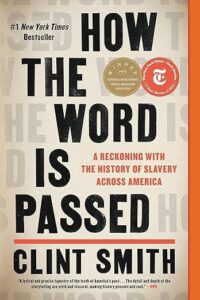
When I previously discussed HOW THE WORD IS PASSED: A RECKONING WITH THE HISTORY OF SLAVERY ACROSS AMERICA by Clint Smith, I realized how woefully inaccurate my knowledge is of critical times and places in the history of our country.1 He documented at great length events at Monticello, Whitney Plantation, Angola Prison, Blandford Cemetery, Galveston TX, New York City and Gorée Island. My gaps in the knowledge of the history in these places I hope was inadvertent, but a close introspection reveals that perhaps it was too easy to gloss over these events as the past and not worthy of further review. I need to discover the uncomfortable facts about slavery and its lingering effects (racism) if I intend to be a positive contributor to our common good. I need to fill those gaps with facts, to learn the lessons of the past, and to advocate for change that is consequential.
But first, let’s address the lingering fear that such a journey can pose. Recent attempts to examine and deal with our less-than-glorious racist past have been called out as unpatriotic, damning our forefathers, or an unwillingness to just let the past be in the past and move on. School boards have been attacked for reasonable efforts to truthfully review our nation’s complete history. Fear-mongering folks have labeled these efforts as teaching “critical race theory” and/or un-American. I do not accept such an analysis. We need to be seeking to accept a truthful introspection as the path forward to advancing the founding principles of our country – that all men [people] are created equal – as well described by Walter Isaacson.2
David Thorson (a tour guide at Monticello) is quoted in Smith’s book when referring to gaps in our historical conscience – “I think that history is a story of the past, using all of the available facts, and that nostalgia is a fantasy about the past using no facts, and somewhere in between is memory.” Our attempts to fill the gaps are often misinterpreted as stomping on someone else’s nostalgia, when, in fact, we are just trying to learn so we can do better in the future and, if need be, to readjust our moral compass going forward. Nostalgia has no place in policy making or goal setting for the future.

This latter distinction is an important one. At my age, I hear so many acquaintances long for the past. They are nostalgic for the way things were, from their perspective. The problem is that this nostalgia, as noted by David Thorson, is often a fantasy based on incomplete information. The gaps that we ignore in history only serve to perpetuate false nostalgia or continue a false narrative. When doing so, we continue to deny what defines our history.
For example, Smith notes that “the history of slavery is the history of the United States. It was not peripheral to our founding; it was central to it. It is not irrelevant to our contemporary society; it created it. This history is in our soil, it is in our policies, and it must, too, be in our memories.” He concludes, “at some point it is no longer a question of whether we can learn this history but whether we have the collective will to reckon with it.”
I am seriously concerned about our children. An inaccurate rendering of history and our inability to address such deficiencies bodes poorly for future in building a fair and equitable society. Mistruths are equivalent to lies, and the cost of lies is a series of terrible things.3 They erode personal trust and social trust. They can set us up for disaster or they can impede our recovery from disaster. They harm our relationships and hurt our self-esteem. Lies have a cost because they multiply; because they tear at our moral fabric; because they can become unrecognizable. When these things occur, we lose our moral compass and can be unfaithful to ourselves, our loved ones, our fellow citizens, and others that need us. And our children suffer disproportionate effects due to their vulnerability.
We have to address the gaps. We have to reckon with the gaps. Nostalgia is largely not an accurate reflection of history and is filled with multiple gaps. Only by addressing the gaps can we aspire to be the country that we were created to be and the country that we profess to be now. History is complicated but so is life. Only “clear eyes and full hearts” (to use an apt phrase) are the tools going forward to open minds that are willing to work together in the tough work ahead.
- Smith C. How the Word is Passed: A Reckoning with the History of Slavery Across America. Little, Brown and Company, 2021. 336pp.
- https://mychildrenschildren.com/a-declaration-for-children/
- https://mychildrenschildren.com/the-cost-of-lies/